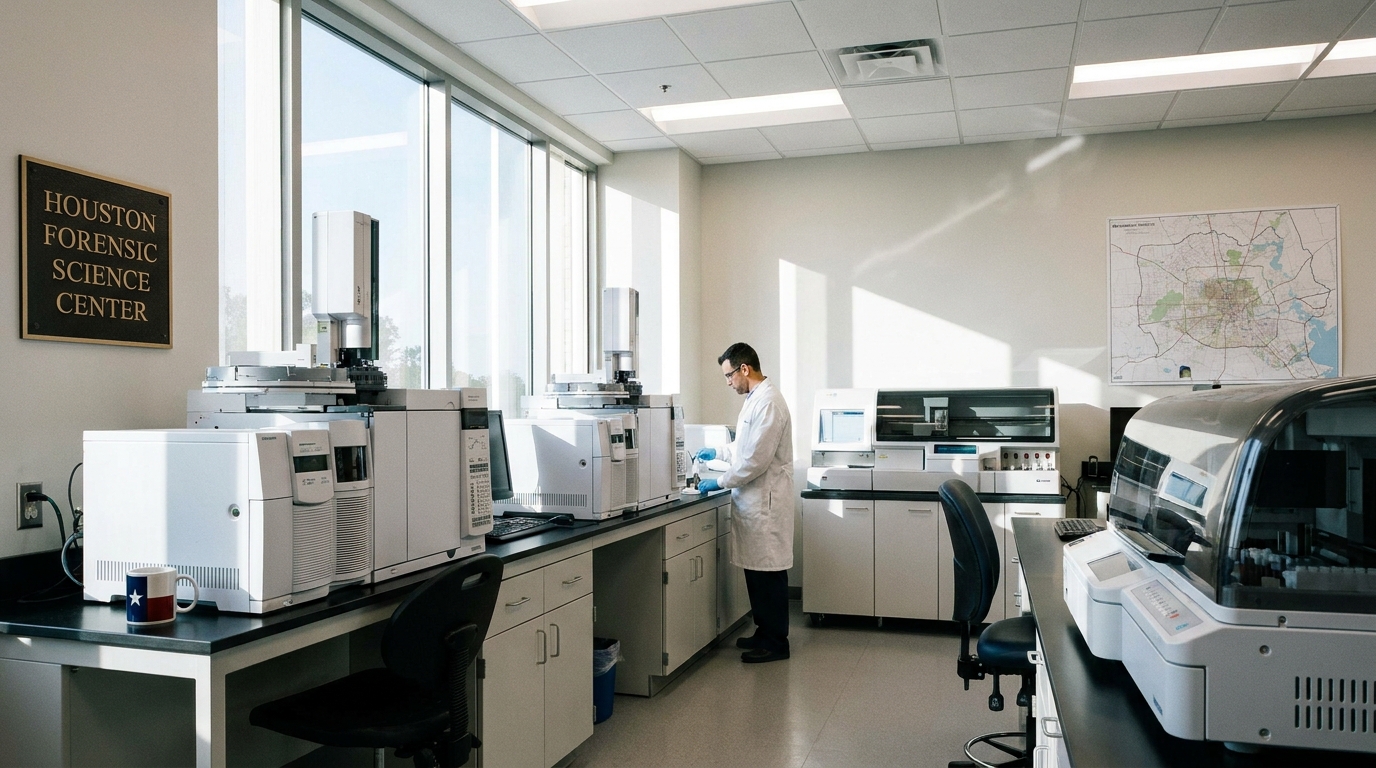
Texas DWI Lab Issue: Can Duplicate Testing Results Create Reasonable Doubt?
Yes, in a Texas DWI case, duplicate blood test results and repeat injections can create reasonable doubt if the numbers do not properly agree, if the lab failed to follow its own protocols, or if the forensic toxicologist cannot reliably explain the uncertainty in the measurements. When the science behind a blood alcohol result is unclear, inconsistent, or poorly documented, a judge or jury can decide that the State has not proven your blood alcohol concentration (BAC) beyond a reasonable doubt. Understanding how duplicate testing works is critical if you are asking whether the lab results in your case are as strong as the prosecutor says they are.
If you are a mid‑career professional in Houston, you probably want a clear, technical explanation, not marketing talk. This article walks through what duplicate blood testing and repeat injections really are, how result agreement is judged in Texas DWI labs, why forensic toxicology uncertainty matters, and how those issues can become cross‑examination points that may support a DWI defense.
What duplicate blood testing and repeat injections actually mean in a Texas DWI case
Almost every Texas DWI blood test is run on a gas chromatograph, sometimes paired with mass spectrometry. The machine draws a tiny sample from your blood tube and runs it through the instrument, which produces a BAC number. To check reliability, labs usually perform duplicate testing or repeat injections. That means either running the same blood tube through the instrument more than once, running two separate vials from the same blood draw, or both.
For you as an Analytical Professional, the key question is not just "what was my BAC number," but "how consistent and defensible are the numbers behind that BAC." If the duplicate injections or duplicate vials do not agree within the lab’s own criteria, that becomes a technical issue that a defense lawyer can explore with the State’s toxicologist.
What “agreement” between duplicate blood test results means
Labs do not expect two blood alcohol tests to be identical. Instead, they set an acceptable range of agreement. For example, a lab may require two duplicate injections to be within a certain concentration difference of each other or within a set percentage. If the first run is 0.083 and the second is 0.091, the lab will decide whether that spread is acceptable based on its written protocol.
If the difference between duplicate blood test results is larger than the protocol allows, a careful Houston DWI defense attorney can argue that the machine or the process was not performing reliably. Even if the difference is technically “acceptable,” the size of that difference can still be used to highlight forensic toxicology uncertainty and to challenge how confidently the State claims to know your true BAC.
Quick glossary for technical terms
If you want to drill into terminology like “matrix effect,” “calibration curve,” or “measurement uncertainty,” it can help to keep a quick reference handy. You can review concise definitions of forensic and toxicology terms used here while you read this article.
How Texas implied consent and blood draws set up these lab issues
Under Texas law, drivers are subject to implied consent rules that govern when and how police can request a breath or blood test. In many DWI cases in Houston and surrounding counties, officers rely on a blood draw rather than breath testing, especially if there is an accident, suspected drugs, or a refusal of breath.
The Texas implied-consent statute for chemical testing explains when officers can ask for a sample, what happens if you refuse, and how a warrant can be used. Every step from the initial decision to draw blood, to transportation, to storage, to analysis in the lab, creates opportunities for error. If you are worried about your career, you should remember that chain‑of‑custody and lab procedures are not academic points. They are the foundation the prosecutor needs to admit and rely on your BAC number in court.
Early ALR deadline sidebar: if you are worried about your license and job
Problem Aware Provider: If you hold a professional license or drive for work, you are right to focus on your driving privileges and job risk as well as the criminal case. In Texas, if you either refuse a chemical test or fail it (for example with a BAC of 0.08 or higher), you usually have only 15 days from the date of arrest to request an Administrative License Revocation (ALR) hearing.
If you miss that 15‑day window, your license suspension can go into effect automatically, often for 90 days or more for a first failure, and as long as 180 days or longer for a refusal, depending on your history. The Texas DPS overview of the ALR license-suspension process is a useful reference if you want to see the State’s explanation of how this works. The ALR process also creates an early opportunity for a lawyer to start gathering evidence and cross‑examining the arresting officer, which can later connect to lab issues and duplicate blood test questions in your criminal DWI case.
How duplicate blood test results can strengthen the State’s DWI case
Before looking at how duplicate blood test results can create reasonable doubt in Texas DWI cases, it is honest to acknowledge that sometimes they help the prosecution. If the lab followed its written procedures, maintained its equipment, and produced duplicate tests that are tightly grouped, a judge or jury may see that as reinforcing the reliability of the reported BAC.
Examples of when repeat injection blood alcohol test results look strong
- Very close duplicates: Suppose two valid injections on the same sample read 0.121 and 0.123. That tight range suggests low random error.
- Consistent results across vials: If two separate vials drawn from you at the same time test at 0.119 and 0.122, the State will argue that the overall process was stable.
- Proper calibration and controls: If the lab’s calibration checks, controls, and blanks all look clean, prosecutors will say the duplicate agreement confirms a trustworthy BAC.
For a professional in Houston who lives in metrics and performance reviews, high‑quality duplicate agreement can feel like a strong data point in the State’s favor. That does not end the analysis, but it does shift the focus to deeper issues like whether the blood sample itself may have been contaminated or whether the reported BAC reflects your level at the time of driving.
How duplicate blood test results can weaken the State’s case and support reasonable doubt
On the other hand, the same duplicate and repeat injection data can expose weaknesses. The lab’s own paperwork may show inconsistencies that do not line up with its protocols or with what the State’s expert is saying in court.
Key patterns that can raise doubt in duplicate blood test results DWI Texas cases
- Out‑of‑tolerance duplicates: If duplicate injections on the same sample differ by more than the lab’s stated tolerance, the toxicologist should be forced to explain why the result was still reported or whether it should have been invalidated.
- Large spread between vials: Suppose vial A shows 0.089 and vial B shows 0.104. Even if both are above 0.08, that spread raises questions about how accurately the lab can pinpoint your true BAC.
- Re‑runs without explanations: Sometimes a chromatogram looks poor, so the analyst re‑runs the sample. If there are several runs with inconsistent numbers, but only the highest one is reported, a defense lawyer can attack that selective reporting.
- Instrument problems on the batch: If other samples on the same run had issues like failed controls or contamination, your duplicate results are pulled into that context.
For you as an Analytical Professional, this is where your instincts about data integrity come into play. When outputs are inconsistent with the system’s own rules, you know not to blindly accept the summary number on the last page of the report. The same logic applies in a Houston DWI courtroom: inconsistent duplicate results can be used to argue that the State simply cannot say, beyond a reasonable doubt, what your BAC actually was.
Micro‑story: a Houston professional and inconsistent duplicate results
Consider a fictional but realistic example. A mid‑level manager in the Energy Corridor is stopped after a work dinner and later arrested for DWI. A blood sample is drawn and sent to a Houston‑area lab. The lab runs duplicate injections and reports a BAC of 0.086.
On the surface, that looks like a straightforward “over the limit” case. But when the defense lawyer obtains the full underlying data, the duplicates actually read 0.079, 0.086, and 0.091 from different injections, and one of the quality‑control checks on the same batch barely passed. Under cross‑examination, the analyst admits that the lab’s protocol calls for closer agreement than what occurred here.
In that scenario, a jury could reasonably conclude that the State has not proven, with the required certainty, that the driver’s true BAC was at or above 0.08 at the relevant time. The DWI case might not disappear, but the supposed precision of the blood number is now open to serious question.
Forensic toxicology uncertainty: what the science really says about blood alcohol numbers
Every scientific measurement has uncertainty. For BAC testing in DWI lab work, that uncertainty comes from sampling, the instrument, the calibration curve, and the matrix of your blood itself. In other words, the number the lab prints is not a perfect reflection of your true alcohol concentration, it is an estimate with a margin of error around it.
In a Texas DWI trial, the State’s toxicologist may try to minimize the size or importance of that margin of error. A prepared defense lawyer can use publications, validation studies, and even the lab’s own standard operating procedures to show that uncertainty is real and sometimes significant. If duplicate results fall on different sides of 0.08, or are widely spread, it becomes easier to demonstrate that margin of error to a jury.
If you want to dive deeper into the science, a Houston‑focused technical primer on forensic toxicology uncertainty can help explain how gas chromatography works, how calibration curves are created, and why seemingly small variations in runs can matter in close cases.
Detail-Oriented Skeptic: why lab audits and expert credentials matter
Detail-Oriented Skeptic: If you naturally distrust broad claims and want hard data, you are not alone. In many Texas DWI cases, issues uncovered in lab audits, proficiency tests, and internal reviews have opened the door for challenges to duplicate testing practices and record‑keeping. A qualified forensic toxicology expert can review batch files, raw chromatograms, and audit materials to see whether the lab truly followed scientific best practices, or whether the appearance of certainty in your BAC number is more fragile than the State suggests.
Key lab factors that affect duplicate agreement and uncertainty
When you evaluate whether duplicate blood test results can create reasonable doubt in Texas DWI cases, it helps to understand the main variables that influence agreement between tests.
1. Chain of custody and sample integrity
Chain of custody tracks who handled your blood sample, when, and how it was stored. Breaks in this chain, missing signatures, or unclear transfers can raise the possibility of mix‑ups, contamination, or improper storage conditions that affect test results.
Problems can include:
- Blood stored outside recommended temperature ranges
- Samples transported without proper sealing or documentation
- Unclear labeling or barcodes that could be confused with another person’s sample
When chain‑of‑custody evidence is weak, your attorney can connect that to any inconsistency or oddity in duplicate test results. If one vial shows a significantly higher or lower value than another, sample integrity questions become even more important.
2. Instrument calibration and maintenance
Gas chromatographs require careful calibration using known standards, along with routine maintenance and checks. If calibration records are incomplete or show that the instrument was out of tolerance close to when your sample was tested, that can undermine confidence in all the results from that time period.
For you, this means that “agreement” between duplicates on a poorly calibrated instrument does not automatically prove the number is valid. Two wrong numbers can still match each other. A skilled defense attorney will often request calibration data and maintenance logs to see whether the lab’s own records support the State’s claims about reliability.
3. Matrix effects and sample preparation
Your blood contains proteins, fats, and other substances that can interfere with the testing process. These matrix effects can distort results if the method is not properly validated or if the analyst does not handle the sample according to protocol. Improper mixing, incorrect use of internal standards, or evaporation in the vial can all affect repeat injection blood alcohol test results.
When matrix effects are present, duplicate results may show more spread than expected, or the chromatogram may show peaks that raise identification questions. Those problems become fruitful areas for cross‑examination in a Texas courtroom.
4. Timing of the blood draw versus time of driving
Finally, timing matters. Your BAC at the time of the blood draw may not be the same as your BAC at the time you were actually driving. If there is a long delay between driving and testing, even “agreeing” duplicate results leave room for argument about rising or falling BAC, especially if the test is close to the 0.08 threshold.
For a Houston professional who may have had several drinks over a long dinner, a careful analysis of drinking timeline, food intake, and metabolism, paired with lab uncertainty, can become a central defense theme.
How these lab issues translate into DWI courtroom defenses in Texas
Understanding the science is important, but you also need to know how it actually plays out in a Harris County or surrounding‑county courtroom. Duplicate test results, repeat injections, and uncertainty rarely win or lose a case by themselves. Instead, they become tools that a defense lawyer can use to educate the judge or jury about why the BAC number is less certain than it looks.
Cross‑examination topics that often come from duplicate testing
- Whether the lab followed its own written tolerance limits for duplicate agreement
- Why any out‑of‑range duplicates were still accepted and reported
- Whether the analyst re‑ran the sample, and if so, why
- How big the method’s validated uncertainty range is at the reported BAC level
- Whether the reported value is rounded up, rounded down, or truncated
When jurors hear that the "official" BAC of 0.084 might realistically represent a range that dips below 0.08 once uncertainty is considered, they may question whether the State has met its burden of proof. If you want to see how lawyers typically connect these concepts to broader defenses, a Houston‑specific guide to common lab, chain-of-custody, and expert-challenge strategies can show the larger picture.
Using experts to explain forensic toxicology uncertainty
In close or complex cases, especially those involving accidents, injuries, or professional drivers, a defense team may bring in its own forensic toxicology expert. That expert can calculate uncertainty, reconstruct BAC at the time of driving, and critique the lab’s handling of duplicates and repeat injections.
For someone in your position, this is where you see the difference between a surface‑level challenge and a fully developed scientific defense. The expert does not simply say “the lab could be wrong,” but instead walks the factfinder through method validation, quality control data, and how the specific duplicate results in your case fit within the lab’s own validation studies.
Executive/High-Profile: discretion, public records, and technical defenses
Executive/High-Profile: If your main concern is keeping your name out of headlines or search results, technical challenges to DWI blood tests serve more than one purpose. They can create leverage for outcomes that avoid trial and limit public exposure, such as dismissals, reductions, or other resolutions that keep sensitive details out of open court. When lab issues are real and well‑documented, they sometimes support negotiations that protect both your record and your privacy, which can be critical for executives and public figures in Houston and surrounding communities.
When to challenge duplicate blood test agreement and how it works in practice
Not every case calls for a full forensic attack, but many do. You are more likely to benefit from a deep dive into duplicate results and uncertainty if your reported BAC is close to 0.08, if there were accidents or injuries, or if your professional life makes a DWI conviction especially damaging.
A detailed guide on how to challenge duplicate blood test agreement in court can give you a sense of how chain‑of‑custody, lab error, and cross‑examination strategies come together in real cases.
Unaware Young Driver: simple takeaway about duplicate tests
Unaware Young Driver: If you are newer to driving or have never dealt with the legal system, the big idea is simple. Duplicate blood tests and repeat injections are supposed to make results more reliable, but when they do not match well or when the lab cuts corners, those problems can be used to challenge the case. Even if you feel embarrassed or overwhelmed, do not ignore deadlines like the 15‑day ALR window and do not assume that a high‑tech blood test automatically means you have no options.
Common misconception: “If the lab ran the test twice, it must be right”
A frequent misconception in Texas DWI cases is that running a blood test twice guarantees accuracy. In reality, repetition only helps if the instrument is functioning properly, the method is validated, and the lab follows its own rules for acceptable agreement.
Two similar numbers can still be wrong if, for example, the blood tube fermented because it was not refrigerated, or the internal standard solution was prepared incorrectly. Conversely, two different numbers are not automatically evidence that you are guilty of something worse. Instead, significant disagreement can be a sign that the system is unstable or that more investigation is needed. The law still requires the State to prove your BAC and impairment beyond a reasonable doubt, regardless of how confident the printout looks.
Houston DWI defense perspective: seeing your blood test like a data set, not a single number
From a Houston DWI defense standpoint, one of the most helpful shifts is to see your blood test not as a single magic number, but as a data set with context. That data set includes duplicate readings, control samples, calibration checks, timestamps, and chain‑of‑custody entries. Each of those points can either support or undercut the State’s story about what your BAC was.
If you spend your days making decisions from spreadsheets and reports, this way of thinking will feel familiar. Just as you would not sign off on a major project based on one unexplained data point, a judge or jury can be persuaded not to convict based solely on a BAC number that is divorced from its scientific context.
FAQ: key questions about can duplicate blood test results create reasonable doubt in Texas DWI
Can duplicate blood test results create reasonable doubt in a Texas DWI case?
Yes, duplicate blood test results can create reasonable doubt in a Texas DWI if they do not agree within the lab’s own tolerance limits, if there are unexplained re‑runs, or if uncertainty around the number makes it unclear whether you were actually at or above 0.08. When cross‑examination exposes these weaknesses, judges and juries may decide the State has not met its burden of proof.
How close do repeat injection blood alcohol test results need to be to count as “agreement”?
Each lab sets its own criteria, often in terms of an allowed difference in concentration or a percentage difference between injections. For example, some protocols might allow only a small spread between duplicates, while others are more lenient. If your results fall outside those rules, that inconsistency can become a defense issue in a Houston DWI trial.
Does it matter if one blood test result is below 0.08 and another is above it?
Yes, that kind of split can be very important. If one duplicate result is under 0.08 while another is over, it supports an argument that the State cannot say, beyond a reasonable doubt, which side of the legal limit your true BAC was on at the relevant time. That is especially significant for professionals in Texas who are worried about the long‑term impact of a DWI conviction.
How long will a Texas DWI with a blood test stay on my record if I am convicted?
In Texas, a DWI conviction generally stays on your criminal record permanently unless it is later sealed or otherwise limited by law. That is one reason technical defenses involving duplicate tests and uncertainty can matter so much, especially for mid‑career professionals in Houston and Harris County whose backgrounds may be checked for promotions or licensing.
Do Houston judges and juries really care about forensic toxicology uncertainty?
They can and often do when it is explained clearly. Many jurors are familiar with error bars and margins of error from everyday life, so when they hear that BAC numbers also have built‑in uncertainty, they are open to that concept. The key is having a lawyer and, when appropriate, an expert who can translate the science into straightforward courtroom language.
Why acting early on Houston DWI lab issues and duplicate testing matters
If you are reading this soon after a DWI arrest in Houston or a nearby county, you are in the best position to protect your options. Early action can preserve ALR deadlines, ensure that blood samples and lab records are requested promptly, and give enough time to bring in a toxicology expert if the case calls for it. Waiting until right before a court date can make it harder to obtain key lab materials, analyze duplicate results, and build a thorough challenge to the State’s evidence.
For an Analytical Professional, the most important takeaway is that your DWI blood test is not just a yes‑or‑no result. It is a complex scientific process that can be scrutinized. Duplicate blood tests, repeat injections, and measurement uncertainty can strengthen or weaken the prosecution’s case depending on how they were handled. A qualified Texas DWI lawyer who understands these technical issues can help you evaluate whether there is room to argue reasonable doubt based on the specific data in your file.
If you want more detailed, interactive explanations of how these lab issues play out in practice, you can use an interactive Q&A for technical DWI evidence questions as a starting point for the deeper questions you may have about your own situation.
To complement what you have just read, you may find it helpful to watch a short visual explainer on how Texas DWI blood testing actually works, how BAC numbers are generated, and what common lab issues like calibration, sampling, timing, and repeat injections mean in real cases.
Butler Law Firm - The Houston DWI Lawyer
11500 Northwest Fwy #400, Houston, TX 77092
https://www.thehoustondwilawyer.com/
+1 713-236-8744
RGFH+6F Central Northwest, Houston, TX
View on Google Maps

No comments:
Post a Comment