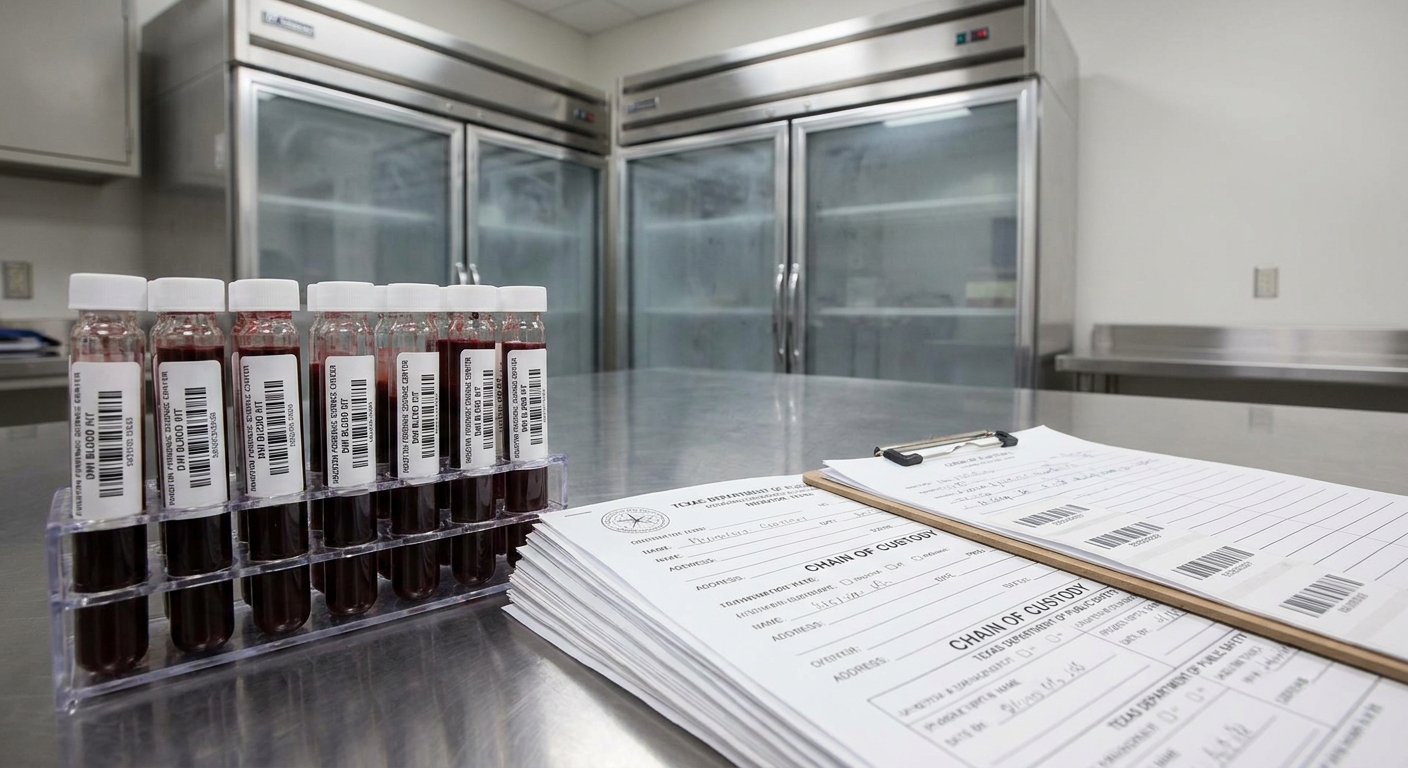
Can a Sample Mix Up Create Reasonable Doubt in a Texas DWI Case?
Yes, a documented or credible risk of a blood sample mix up can create reasonable doubt in a Texas DWI case, especially if labeling, accession numbers, or the chain of custody are unclear or inconsistent. Texas courts expect the State to prove that the blood tested actually came from you, was labeled and tracked correctly, and was not contaminated or switched along the way, and any serious doubt about that path can weaken the prosecution’s test results.
If you are a Houston area worker who just got a DWI and you are staring at a lab report, it is easy to feel like that one blood alcohol number decides everything. This guide walks through how Texas DWI labs are supposed to handle blood, how sample mix ups really happen, and what kinds of problems can raise questions in court without getting lost in technical jargon.
Why Lab Mix Ups Matter So Much When Your Job And License Are On The Line
You already know what is at stake. A guilty DWI can threaten your commercial projects, your driving record, your insurance, and even your ability to get to the job site. In Texas, a first time DWI can bring fines, possible jail time, and license suspension that can last from 90 days up to a year or more depending on your record and test results.
On top of the criminal case, Texas has a separate Administrative License Revocation (ALR) process that can suspend your license just based on a failed or refused test. The Texas DPS overview of the ALR license suspension process explains how quickly those deadlines come up and why many drivers are surprised by a civil suspension even before their criminal case is resolved.
When so much rides on one blood test, you deserve to understand how that blood was labeled, stored, and tested. You also deserve to know that you are allowed to question whether the number is reliable, especially if there is any sign of a sample mix up DWI blood test Texas wide.
Big Picture: How Texas DWI Blood Tests Are Supposed To Work
Before you can spot problems, it helps to know the basic steps for a Texas DWI blood draw and lab test. This process is similar in Houston, Harris County, and nearby counties, even though the exact hospital or lab may differ.
Step 1: Traffic Stop, Arrest, And Implied Consent
When an officer pulls you over and believes you are intoxicated, Texas implied consent rules say you are considered to have agreed to provide a breath or blood sample if you are lawfully arrested for DWI. You can read the statute yourself in the Texas implied‑consent law for chemical testing.
If you agree to a blood draw, you are usually taken to a hospital, clinic, or jail facility where a qualified person draws your blood. If you refuse, the officer may seek a warrant, especially in serious or repeat cases.
Step 2: Blood Draw And Initial Labels
During the draw, the person collecting blood should use sterile equipment and fill one or more vacuum tubes that contain preservatives. Each tube should be labeled with key information, such as:
- Your full name or unique ID number
- Date and time of the draw
- The initials or name of the person who drew the blood
- The case number or incident number from law enforcement
At this early stage, a wrong blood sample DWI Texas case can start if two tubes are on the table, the labels are filled out after the draw instead of before, or the wrong sticker goes on the wrong tube. You might never see this, but it can show up later in records.
Step 3: Transport To The Lab
Next, the tubes must be sealed, packaged, and transported to the crime lab or contracted testing lab. Officers usually place them in an evidence box or cooler and log the evidence into a system.
From the moment your blood is drawn until it reaches the lab bench, the chain of custody blood test record should show exactly who had the sample, when, and for what purpose. Each handoff should be logged in writing or in an electronic system.
Step 4: Lab Accessioning And Accession Numbers
When the lab receives the samples, it will enter them into its internal system. This step is called accessioning. The lab assigns a unique accession number or specimen number to your case so staff can track that tube through testing and reporting.
That accession number is one of the most important protections against a sample mix up. If two different people somehow end up with the same accession number, if the number changes along the way, or if the number on the tube does not match the lab report, those are serious red flags.
Step 5: Testing And Reporting
Once accessioned, the lab scientist or technician prepares the sample for gas chromatography or another approved method to measure alcohol in your blood. The lab usually runs control samples, blanks, and calibration checks along with your sample to be sure the instruments are working.
Finally, the lab issues a report with your BAC level, the accession number, the date of testing, and usually the analyst’s name or ID. That report is what the prosecutor will use in court.
For you as a working parent or provider, this lab process can feel like a black box. But every step has paperwork, and that paperwork is where concerns about a lab accession error DWI or sample mix up can surface.
Key Definitions: Labels, Accession Numbers, And Chain Of Custody
When you first look at your blood test packet, it may feel like alphabet soup. Here are simple definitions so you can follow the paperwork.
If you want a deeper dive into terminology, the Butler site has definitions and plain-language explanations of DWI terms that can help you translate police reports and lab documents.
What Is A Label In A DWI Blood Test?
The label is the identifying tag on the blood tube. It can be a sticker, bar code, or hand written tag that usually includes your name or ID, case number, date, and time. Without a legible, accurate label, a lab cannot be sure which person the blood came from.
For you, this means that if the label is missing, smeared, or only partly filled out in your records, it is fair to ask how the lab knew the sample was yours.
What Is An Accession Number?
An accession number is the lab’s internal tracking number. It is different from your police case number. The accession number is tied to the physical tube, the test run, and the final report inside the lab computer system.
If your case shows more than one accession number for the same draw, or if the number on the report does not match the number on the evidence receipt, that could point toward a DWI lab error or data entry mix up.
What Is Chain Of Custody?
Chain of custody is the written record that tracks your blood sample from the time it is drawn until it is tested and stored. Each time someone new takes control of the sample, they should sign or log the transfer with the date and time.
Think of it like a delivery tracking log. If there are gaps or unexplained jumps in that log, your Houston DWI defense team can question who had access to your blood and whether a mix up could have happened.
For a deeper treatment of this topic, another Butler article explains how chain of custody gaps create reasonable doubt when labels are missing or transfer logs are unclear.
How Sample Mix Ups Actually Happen In Texas DWI Labs
You might assume that modern labs are so automated that mix ups never happen. In reality, labs are staffed by human beings working under deadlines, with heavy caseloads, and sometimes with outdated systems. Here are some of the most common ways a sample mix up DWI blood test Texas issue can start.
Labeling Mistakes At The Draw Site
One weak point is the moment of blood collection, often in a busy Houston emergency room or jail clinic. Common problems include:
- Drawing blood from two people back to back, then filling out labels afterward
- Using pre printed labels that belong to a different patient or case
- Writing the wrong name or case number on the tube
- Failing to note the time of draw, which can matter for alcohol curve arguments
Imagine two drivers arrested after a crash on the same night, both brought into the same hospital. If the phlebotomist is rushed and sets two tubes side by side with handwritten labels, it is not impossible for those labels to be switched.
Accession Errors Inside The Lab
Once the tubes reach the lab, staff should compare the labels, the submission form, and any bar codes before entering the case into the system. But human error can still occur:
- Typing the wrong case number when creating the accession entry
- Assigning the same accession number to two different samples
- Mixing up bar codes when placing vials in a testing rack
- Pulling the wrong tube from a refrigerator for analysis
These kinds of errors might be rare, but they are real enough that labs build safeguards around them. For you as a construction manager, it may be like mislabeling materials or plans on a job site. One wrong label can send crews in the wrong direction, even if most days everything is done correctly.
Data Entry And Report Mix Ups
Even after a correct test, data entry mistakes can connect the wrong BAC result to the wrong person:
- Typing the wrong name when generating the report
- Copying and pasting results into the wrong case file
- Printing labels for court packets that do not match the original evidence ID
For an Analytical Decision-Maker, this is where you may want to see exact lab standard operating procedures and compare them with your documents to decide whether the odds of error are meaningful in your situation.
What Courts Expect: Prosecutors Must Prove A Clean Chain Of Custody
Texas courts do not require the State to disprove every wild theory about a mix up. But they do require prosecutors to show that the blood tested was more likely than not your blood and that it was handled in a way that keeps it trustworthy.
In practice, that means the State usually brings in an officer or nurse to talk about the draw, plus a lab analyst to explain accession, handling, and testing. The paperwork, labels, accession numbers, and chain of custody forms are used to support that story.
If you are worried about wasting money on an ineffective defense, it helps to know that experienced Houston DWI defense lawyers often study those records as part of common defense strategies against DWI evidence, not as a one in a million long shot.
Reasonable Doubt Vs. Mere Possibility
A key point is the difference between a mere possibility and reasonable doubt. Saying “someone somewhere could have swapped my sample” is not enough. But showing that your accession number appears twice, or that there is a 12 hour gap in custody with no explanation, is different.
Courts will look at the total picture, including how serious any error is, whether there are multiple problems, and whether the lab took steps to fix or document the issue. Your job is not to prove tampering, but to highlight enough specific questions that a juror cannot be sure beyond a reasonable doubt.
Common Misconception: Any Small Error Automatically Throws Out The Test
One common misunderstanding is that any small paperwork mistake will make the entire blood test disappear. That is rarely true. Many minor typos or harmless errors can be explained and may not persuade a judge or jury.
The focus is on errors that affect identity, integrity, or accuracy. Missing labels, mismatched accession numbers, and documented custody gaps carry more weight than a misspelled street name on one form.
Concrete Warning Signs That Might Support A Sample Mix Up Argument
You do not need to become a scientist overnight, but you can look for simple problems in your records. Here are concrete issues that sometimes help create reasonable doubt.
1. Missing Or Illegible Tube Labels
If the evidence photos or descriptions show tubes with no name, no case number, or handwriting that is impossible to read, that is a serious concern. Ask yourself: how would a stranger know this tube belonged to you rather than another driver from the same night.
2. Wrong Or Conflicting Personal Information
Look for errors such as:
- Wrong date of birth on the lab paperwork
- Wrong gender or age range noted
- A different spelling of your name than what appears on other forms
A single typo might not carry the day, but multiple identity errors can support an argument that the wrong blood sample DWI Texas case is tied to your name by mistake.
3. Duplicate Or Changing Accession Numbers
This one is crucial. Your lab report, evidence submission form, and internal lab notes should all show the same accession number for the same blood draw date and time. If one page shows 24 1123 and another shows 24 1128, you may be looking at two different cases or a lab accession error DWI situation.
Duplicate accession numbers across different people are rare but very powerful if proven. Even the hint of that sort of confusion can give jurors pause.
4. Unclear Chain Of Custody Logs
Chain of custody forms should read like a clean timeline. Problems include:
- Blank spaces where someone should have signed for the evidence
- Sudden jumps from “officer” to “analyst” with no middle steps
- Times or dates that do not make sense, like testing before the draw date
Your stress about missing work and paying the mortgage is real. Seeing paperwork that looks careless can add to that stress, but it can also be a clue that the test is not as solid as the State claims.
5. Storage Issues And Temperature Concerns
Improper refrigeration or long delays between the draw and testing can affect a sample. While this is more about accuracy than identity, storage problems can also suggest generally sloppy handling that might support your broader DWI lab error arguments.
Micro Story: How A Simple Label Error Raised Reasonable Doubt
Picture someone a lot like you. A project manager in his mid 30s is stopped driving home after a long shift on a Houston site. He is polite, surrenders his license, and agrees to a blood draw at a local hospital. Months later, the lab report shows a high BAC that could cost him his license and his role overseeing crews on remote locations.
When his lawyer finally gets the records, they notice that the tube label photo in the evidence file is smudged. The handwriting on the tube looks more like a different last name, and the date of birth is one digit off. The accession log also shows a gap of almost a full day between when the hospital staff logged the tube and when the lab logged it in.
In court, the nurse admits she drew blood from several DWI patients in a row on the same night and sometimes filled out labels quickly after the draws. The analyst admits he cannot say exactly where the tube was during that 24 hour gap, only that it was “likely” in a cooler.
No one can prove the tube definitely belonged to someone else, but the combination of a smudged label, wrong birth date, and custody gap gives jurors a real reason to wonder. That kind of layered issue is much stronger than a single small typo.
Sidebars For Different Types Of Readers
High-Stakes Executive: If you are a senior leader, your biggest concerns might be confidentiality and your long term record rather than the technical chemistry. Chain of custody reviews and lab mix up questions can often be pursued quietly through discovery and expert consultation before anything becomes public in a courtroom.
Prepared Power-User: If you already know about validation studies, chromatograms, and proficiency tests, you may want a stepwise list of lab documents that can expose DWI lab error issues. You can use a stepwise blood-test challenge checklist for lab errors to organize requests for raw data, instrument maintenance logs, and quality control charts.
Casual Risk-Taker: Here is the quick, shocking takeaway: one rushed label or wrong number in a busy Texas DWI lab can link someone else’s blood to your name, and by the time anyone notices, your license and job can already be on the line. Acting early to collect and review records is often the only way to catch those mistakes.
How Challenging Lab Evidence Fits Into A Houston DWI Defense Strategy
Lab mix up arguments do not exist in a vacuum. They are part of a bigger picture that includes the traffic stop, field sobriety tests, video, and your medical history. In some cases, even a strong lab issue might mainly be used to negotiate a better outcome rather than to seek dismissal at trial.
For someone responsible for a crew or project schedule, this means you want a defense strategy that looks at lab issues alongside other factors, such as whether the officer had a legal reason to stop you at all, whether your rights were respected, and whether the test was taken too long after driving to be reliable.
Houston DWI defense lawyers often combine chain of custody questions with the broader common defense strategies against DWI evidence such as challenging the stop, the arrest, and the officer’s observations. The goal is to create multiple layers of doubt or leverage.
Practical Steps You Can Take To Evaluate Lab Mix Up Concerns
Even if you are still deciding how to move forward, there are practical steps you can take now to protect yourself and your ability to challenge a possible sample mix up.
1. Act Quickly On ALR And License Deadlines
Texas gives you a short window, often just 15 days from receiving a notice of suspension, to request an ALR hearing. Since you need your license for work, missing this deadline can hurt you before you ever get to raise lab issues in court.
The Texas DPS overview of the ALR license suspension process explains the basic steps and what to expect. Make sure you pay attention to any dates listed on your paperwork.
2. Preserve And Request All Records
You or your lawyer can request:
- Police reports and offense narratives
- Blood draw forms and hospital records
- Evidence photos of the tubes and labels
- Lab accession logs and worksheets
- Chain of custody forms
The sooner these documents are requested, the less chance there is that something gets lost or destroyed under routine retention policies.
3. Compare Numbers Across Documents
Once you have records, you can sit down with a pen and highlight:
- Your name and date of birth
- The incident or case number used by police
- The accession number used by the lab
- Dates and times of draw, receipt, and testing
If any of these change between pages, or if they are missing entirely on some documents, that might support questions about sample identity or a DWI lab error.
4. Consider Independent Expert Review
In many Texas DWI cases, a defense team will consult an independent forensic toxicologist or lab expert. That expert can review the records, explain whether the lab followed its own rules, and identify any technical violations that might not be obvious at first glance.
For an Analytical Decision-Maker who likes data, an expert report can help you see the odds more clearly instead of guessing whether your concerns are realistic or not.
5. Integrate Lab Issues With Your Life Realities
As a provider, your main questions are often practical. Will this cost me my driver’s license for six months. Will I still be able to supervise projects in surrounding counties. Will my insurance skyrocket. All of these depend not just on the BAC number, but on the strength of the whole case and how it is resolved.
Lab mix up and chain of custody arguments are tools that may protect you from the worst outcomes or open the door to alternative resolutions. They are not magic wands, but they are often worth exploring carefully.
FAQ: Key Questions About Can Sample Mix Up Create Reasonable Doubt In A Texas DWI Case
Can a sample mix up really get a Texas DWI case dismissed?
A proven or strongly supported sample mix up can sometimes lead to suppression of the blood test or a dismissal, but that outcome is not guaranteed. Courts look at how serious the error is, whether there is other evidence of intoxication, and whether the State can fix the problem by calling more witnesses or records.
How often do DWI lab errors actually happen in Houston or Harris County?
Labs work hard to reduce mistakes, so major mix ups are not common, but minor paperwork errors are seen more frequently. The key for your Houston case is not statewide statistics, but whether your own records show specific problems with labels, accession numbers, or chain of custody.
What is the difference between a lab accession error and a chain of custody problem?
A lab accession error usually means the lab entered or tracked your sample under the wrong internal number, which can mislink results and people. A chain of custody problem is about who had the sample when, and whether the paperwork clearly covers each handoff from draw to testing.
Can I challenge a Texas DWI blood test even if the BAC number is very high?
Yes, you can still challenge the reliability of a blood test even if the reported BAC is well above the legal limit. Issues such as a wrong blood sample DWI Texas situation, contamination, or serious custody gaps can raise questions about any reported number, not just borderline results.
Do Houston judges and juries really care about small paperwork mistakes?
Judges and juries are more persuaded by clear, concrete problems than by technical nitpicking. A missing label, conflicting accession numbers, or a full day where no one can say where your blood was stored usually matters more than a simple spelling error on one form.
Why Acting Early On Lab And Chain Of Custody Issues Matters
Once you understand how samples are labeled, numbered, and tracked, you see why time matters so much. Video can be overwritten, hospital records can be archived, and some labs only keep certain data for limited periods. Waiting too long can quietly erase the very proof you would need to show a sample mix up or DWI lab error.
If you are carrying the weight of a family, a mortgage, and workers who count on your leadership, it is understandable to feel frozen after a DWI arrest. But taking early, informed steps to gather records, note deadlines, and understand terms like chain of custody and accession number can protect both your rights and your long term stability.
For readers who want a more interactive way to explore these issues, an interactive Q&A resource for common DWI lab questions can help you think through what to ask and what documents to look for in your own case.
Getting informed about sample mix up risks does not mean your case will automatically disappear, but it does mean you are no longer letting a single lab number control the whole story. Instead, you are learning how that number was created, how it can sometimes go wrong, and how reasonable doubt can arise when the State’s own records do not line up.
Below is a short video that explains how Texas DWI blood tests work and where issues such as labeling, accession, and transfer errors can occur. It can help you visualize the process you just read about so you can better understand your own lab paperwork.
Butler Law Firm - The Houston DWI Lawyer
11500 Northwest Fwy #400, Houston, TX 77092
https://www.thehoustondwilawyer.com/
+1 713-236-8744
RGFH+6F Central Northwest, Houston, TX
View on Google Maps

No comments:
Post a Comment