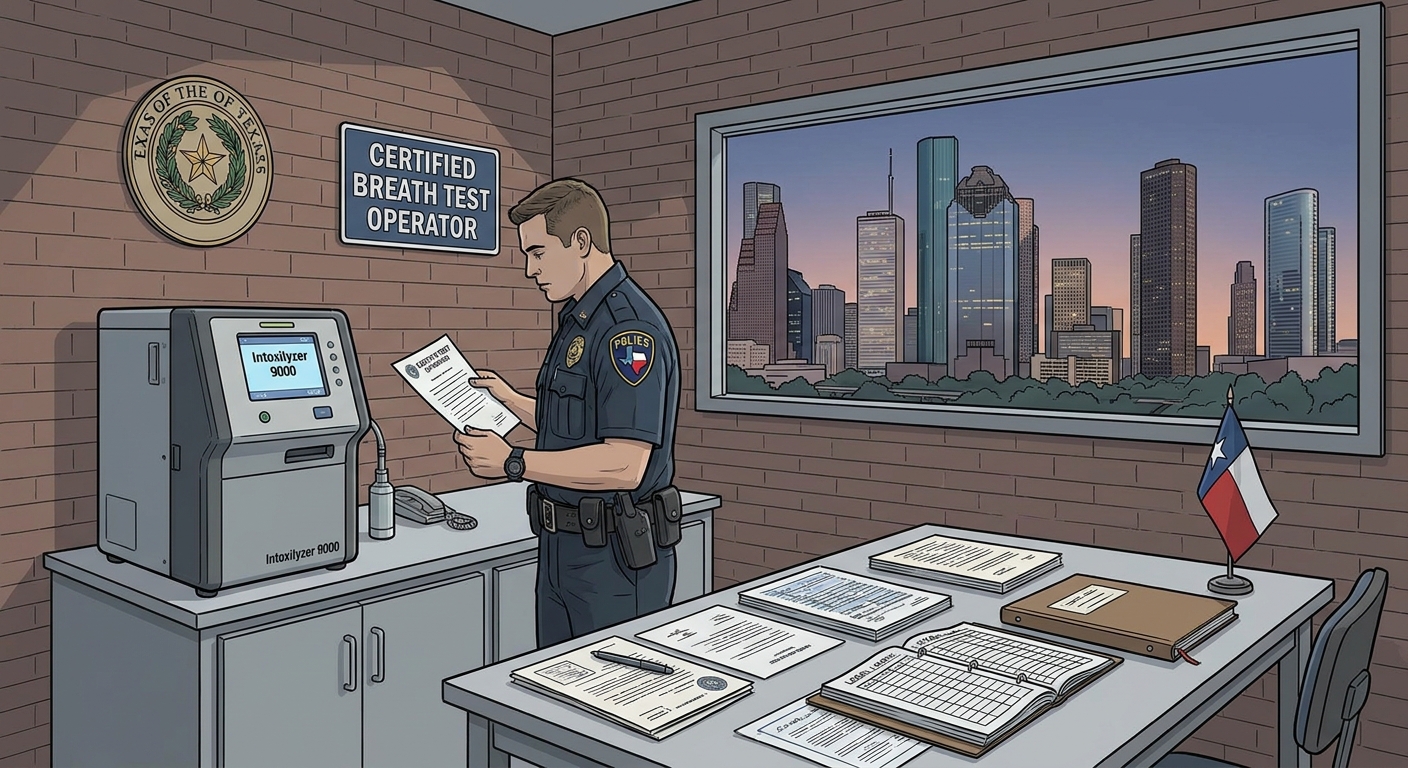
Can Breath Test Operator Certification Problems Affect a Texas DWI Case?
Yes, breath test operator certification problems can affect a Texas DWI case, because Texas law and Texas Department of Public Safety (DPS) rules require that Intoxilyzer breath tests be run by properly trained and certified operators for the results to be considered reliable. If the operator was not currently certified, trained on the right machine, or following required procedures, a judge may limit or exclude the breath test, and a jury may give the number far less weight.
If you are a detail focused professional in Houston looking at every technical angle, you are right to focus on breath test operator certification. In many Harris County DWI cases, the fight is not about whether a machine printed a number, but whether that number is trustworthy enough to help convict you.
Big Picture: How Operator Certification Fits Into a Texas DWI Case
In Texas, most roadside and stationhouse breath tests use an Intoxilyzer device that measures breath alcohol to estimate blood alcohol concentration (BAC). Texas courts treat these tests as scientific evidence, so they must meet legal standards for reliability that include:
- An approved device
- Proper maintenance and calibration
- A certified breath test operator
- Compliance with Texas DPS rules and the Office of the Scientific Director guidelines
When you ask whether breath test operator certification problems can affect a Texas DWI case, what you are really asking is whether those problems can undermine reliability and admissibility. The answer is often yes, especially when a lawyer is prepared to dissect training records, certification dates, and the operator's specific role in your test.
For a Houston professional with a career and license on the line, that distinction matters. A 0.09 or 0.12 BAC looks scary on paper, but if the wrong person pushed the buttons or skipped steps, that number may not tell the full story.
Key Definitions: Breath Test Operator Certification in Texas DWI Cases
To understand how to attack a breath test, it helps to define a few core pieces of the Texas system.
What is a "breath test operator" in a Texas DWI?
The breath test operator is the officer or technician who actually administers the breath test on the Intoxilyzer. In Texas, this person must hold a specific breath test operator certificate issued under the state technical supervisor program. You may see this referenced as an Intoxilyzer operator certified in Texas or a "certified breath test operator."
Who is the "technical supervisor"?
The technical supervisor is a higher level scientist or specialist who oversees groups of Intoxilyzer machines and operators. They do not usually administer your test, but they are responsible for:
- Approving each device and location
- Maintaining calibration and running control tests
- Training and certifying operators
- Keeping core DWI breath test records and logs
In a contested case, an experienced Houston DWI defense lawyer may cross examine the technical supervisor to show why a certain operator should not have been using the device or why the training was inadequate.
What is operator "certification" in this context?
Operator certification generally includes:
- Initial training class and exam on the Intoxilyzer
- A formal certificate with an issue date and expiration date
- Rules about how long certification lasts and when renewal is required
- Requirements on how many tests the operator must run to stay active
For you, the core question is simple: on the night of your arrest, was the breathalyzer operator training current, and was the officer legally allowed to administer your test under Texas rules?
How Texas Implied Consent and Breath Tests Work
Most Texas DWI breath tests are authorized under the state's implied consent law. When you drive on Texas roads, you give implied consent to provide a breath or blood specimen if an officer lawfully arrests you for DWI. That legal framework is set out in the Texas implied-consent statute for breath and blood tests.
If you refuse, the officer may seek a warrant for blood, and your license may be subject to an Administrative License Revocation (ALR) suspension. If you agree and the test is done by a certified operator using an approved machine, the state will try to use that number as a central piece of evidence.
For a detail oriented reader, the key point is this: the same legal system that empowers officers to ask for a sample also sets strict conditions on how that sample must be handled. Operator certification is one of those conditions, and it is not optional.
Common Operator Certification Problems in Texas DWI Breath Test Cases
In real Houston and Harris County DWI cases, certification problems tend to fall into a few repeat categories. You may see one or more of these when your lawyer pulls the operator's records.
1. Expired operator certification
Sometimes the simplest issue is the most powerful. An officer's breath test operator certificate may have expired weeks or months before your test date. That creates an argument that, at the moment of your test, the person pressing the buttons was not legally an "operator" under Texas rules.
Courts handle this in different ways, but at minimum a skilled defense lawyer will hammer this point with the jury. If you are a professional whose job depends on technical licenses, you understand that expired credentials can have real consequences.
2. Certification on a different machine model
Texas agencies sometimes change from one Intoxilyzer model to another, or update software. An operator may be trained and certified on an older series but not properly trained on the new interface or new protocol. If your test used a newer machine but the operator's records only mention prior equipment, that gap can be fertile ground for cross examination.
3. Incomplete or missing training records
Another common defect is paperwork. The technical supervisor may be unable to produce a complete training file, exam scores, or attendance sheets for a particular operator. There may be gaps in dates or missing signatures. While paperwork glitches do not automatically throw out a test, they support a narrative that the state cannot prove the necessary foundation.
4. Operator not following protocol, despite certification
Even when an operator is technically certified, they still must follow precise procedures, such as
- Observing you for at least 15 minutes to ensure no burping, vomiting, or foreign objects
- Checking the device diagnostics before and after testing
- Running required control tests
- Documenting any irregularities
If cross examination or video shows the officer was distracted, left the room, or rushed the process, your lawyer can argue that the test was not run according to training. For a Detail Focused Professional, this is very similar to a quality control breakdown in your own field.
5. Technical supervisor oversight and audit problems
Sometimes the issue is not the individual operator but the office that trained them. If a technical supervisor has a history of audit findings, missing quality control checks, or outdated manuals, that systemic weakness can spill over into your case.
How Operator Certification Problems Affect Admissibility and Weight of the Breath Test
The next question is practical: when there is a certification defect, what can actually happen in court?
Admissibility: Can the judge keep the breath test out?
Under Texas law, scientific evidence must be shown to be reliable before the jury sees it. A defense lawyer can file a pretrial motion to suppress or a Daubert/ Kelly style challenge arguing that the state cannot meet that foundation. Certification problems can support that motion by showing:
- The test was not administered by a properly certified operator
- The operator did not follow their own training
- The technical supervisor cannot vouch for the process because records are missing
Sometimes judges will allow the test in but limit how it can be described. In other cases, especially with serious defects, part or all of the breath result may be excluded. That is why strong technical defenses for breath test evidence and certifications focus on both operator training and machine reliability together.
Weight: How much the jury should trust the number
Even if the judge lets the breath test in, certification issues can severely damage its weight with a jury. A 0.09 BAC looks very different when the jury has heard that the operator lacked valid credentials on the date of testing or could not explain the machine's safeguards in detail.
As a Houston professional, you know that expert testimony often comes down to credibility. A confident cross examination about operator training can make jurors think twice about relying on a single number to decide your future.
Negotiations: Impact on offers and case outcomes
Prosecutors in Harris County and surrounding counties review the strength of breath test evidence when evaluating plea options. If operator certification appears solid and there are no obvious problems, the state may feel comfortable pushing for harsh outcomes. If your lawyer can show meaningful certification defects, that leverage can shift, sometimes resulting in reductions or alternative resolutions.
There are no guarantees, and every case is different. However, ignoring certification and records almost always gives up a potential advantage.
What DWI Breath Test Records Show About Operator Certification
To expose these issues, your defense team has to request and analyze targeted records. Collectively, these DWI breath test records can answer whether the operator was properly credentialed for your test.
Types of operator related records
- Operator certificate with issue and expiration dates
- Training course completion records and exam results
- Continuing education or recertification logs
- Lists of all breath tests that operator has run
- Any disciplinary notes or internal audits involving that operator
Device and maintenance records that connect to certification
Operator questions do not live in a vacuum. Analyzing them together with machine logs helps build a more complete challenge.
- Intoxilyzer maintenance and repair records
- Calibration and control test logs around your test date
- Location approval documents for the particular station
- Software update records and technical bulletins
If you like to see data in context, pairing operator records with device logs can show patterns, like a cluster of high BAC results taken by a particular operator right after a machine service issue.
Practical Defense Uses: How Lawyers Challenge Breath Test Operator Certification in Texas
An experienced Houston DWI defense strategy does not just gather documents. It puts them to use in a structured way.
1. Establishing the legal foundation
The defense may start by questioning whether the state has met its burden to show an approved device, an appropriate location, and a certified operator. This often happens at a pretrial hearing where the prosecutor calls the technical supervisor to the stand. Your lawyer can walk through each requirement and highlight gaps.
2. Exposing inconsistencies between paperwork and reality
Next, your lawyer may compare operator certificates with shift schedules, arrest times, and video. For example, if the certificate expired 10 days before your arrest but the officer is still labeled as the operator in the report, that creates a concrete inconsistency the jury can understand.
3. Showing real world consequences of poor training
Certification issues carry more weight when the defense can show how they affected your test. That might include:
- Video of the operator failing to maintain a 15 minute observation period
- Evidence that you had medical issues that called for extra care
- Inconsistencies between your appearance and the reported BAC
When a juror sees that a supposedly certified operator skipped steps, your concerns about technical competence will resonate with them.
4. Using experts to explain why certification matters
In some cases, the defense will bring in an independent expert to explain why operator training and certifications are critical to accurate breath testing. For a Busy Executive or a High Net Worth Client, this kind of expert driven narrative can be reassuring because it mirrors how high stakes decisions are made in your own industries.
Micro Story: How Certification Issues Changed the Trajectory of a Houston DWI Case
Consider a composite example that reflects real issues seen in local courts. A financial analyst in Houston, with no prior record, is arrested after a traffic stop. The Intoxilyzer result shows a BAC of 0.11. On paper, the case looks tough.
Her lawyer requests operator and machine records and discovers that the officer's breath test operator certification expired about three weeks before her test. The technical supervisor testifies that renewal paperwork was "in process" but cannot show any documentation that it was approved before the test date.
At a pretrial hearing, the judge allows the test number in but notes the certification problem for the record. At trial, the defense uses cross examination to emphasize that the officer, unlike everyone else in the courtroom, was operating without current credentials. Jurors learn that the officer also left the room twice during the observation period. The case ultimately resolves with a non DWI outcome that avoids a permanent DWI conviction.
Results vary, and no outcome can ever be promised. However, this kind of fact pattern shows why your instinct to scrutinize operator certification is well founded.
Technical Background: Breathalyzer Operator Training and Intoxilyzer Function
To appreciate how breathalyzer operator training interacts with the machine itself, it helps to know the basics of how an Intoxilyzer works. The device typically uses infrared spectroscopy to measure alcohol molecules in a deep lung breath sample. Operators must be trained not just to push buttons, but to recognize problems such as shallow breaths, mouth alcohol, and interfering substances.
If you want a deeper explanation of common error modes and device limits, you can review a technical primer on breath test operation and limits. That kind of background often helps professionals like you understand what to look for in videos and reports.
Secondary Persona Asides: How Certification Issues Look From Different Angles
Stressed Provider: How Certification Flaws Can Protect Your License
If you are a Stressed Provider such as a nurse, teacher, or commercial driver, your main fear may be losing your professional license. Breath test operator problems can matter in your ALR license hearing as well as in the criminal case. Weak or unreliable breath evidence can sometimes make it easier to challenge a proposed suspension or to negotiate terms that help protect your career.
Texas gives you a short window to act. You typically have only 15 days from the date of your DWI arrest to request an ALR hearing. You can read more about urgent ALR hearing deadlines and how they affect evidence and also see the Official DPS portal to request an ALR hearing and deadlines to understand the process.
Busy Executive: Proof of Technical Expertise and Discretion
If you are a Busy Executive, you likely care about two things: technical excellence and discretion. You want to know that any lawyer you speak with can walk into court with operator certification records organized, maintenance logs tabbed, and pointed cross examination prepared. A quiet but aggressive breath test challenge focused on training and certification can often be handled without unnecessary publicity, especially when your lawyer manages communications carefully from day one.
High-Net-Worth Client: Strategies Focused on Long Term Clean Records
As a High-Net-Worth Client, you may be more concerned with long term impact than short term inconvenience. Certification flaws are one of several tools that can support dismissal, reduction, or other resolutions that limit how a DWI affects your record. No strategy guarantees a clean slate, but a detailed review of operator training and device logs is often essential to any plan that aims to minimize what future background checks reveal.
Uninformed Young Driver: Simple Takeaway About Certification
If you are an Uninformed Young Driver, the main thing to remember is simple: breath test machines are not magic, and the people running them must be properly trained and certified. If the operator did not follow the rules or was not certified, that can seriously weaken the breath result. Do not assume that just because a number printed on a screen, your case is hopeless.
Step by Step: Records You Should Expect Your Lawyer to Request
Detail oriented readers often ask for a concrete list to sanity check whether their defense is digging deep enough. While you should not try to handle these requests alone, you can ask whether your lawyer has requested at least the following categories of records.
Core operator and device records checklist
At a minimum, a thorough Texas DWI defense will typically request:
- Operator certification documents for every person who touched your test. This includes certificates, training dates, and renewal records.
- Operator training materials and exams, including the curriculum used, test questions when available, and any continuing education records.
- Intoxilyzer maintenance logs for the specific machine used in your test, covering at least several months before and after your arrest date. For more detail on this, see a step-by-step guide to request Intoxilyzer maintenance logs.
- Calibration and control test records, especially the control tests run on the date of your test and any out of range results.
- Technical supervisor files for the machine and location, including audits and any notices of problems.
- Jail or testing room video capturing the observation period and the test itself.
Seeing these items requested and received should give you more confidence that operator certification issues will not be overlooked in your defense.
How these records are used in court
Once these materials are in hand, your lawyer can build timelines, highlight gaps, and prepare targeted questions. For example, a side by side chart showing an operator's certification expiration date and the date of your test can be a powerful visual aid for a jury that appreciates precise documentation, much like you do in your professional life.
Common Misconception: "If My BAC Was Over 0.08, Certification Details Do Not Matter"
A common misconception is that once the printed BAC is above 0.08, the details of how the test was run no longer matter. In reality, operator training and certification can make or break the reliability of that number.
Think about your own field. A lab result, a financial report, or a compliance statement can look official, but if the person behind it lacked the required license or failed to follow protocol, you would not trust it. Courts and juries can feel the same way about Intoxilyzer results when certification problems are clearly explained.
Why Acting Early on Operator Certification Issues Matters
Time affects how easy it is to uncover certification and training problems. Some records are routinely purged after a certain number of years, and memories fade quickly. The sooner a defense team is involved, the more likely they can secure complete operator files, download videos, and obtain full machine logs before anything is lost.
Early action also intersects with license deadlines. As noted earlier, you normally have 15 days from the date of arrest to demand an ALR hearing. That hearing can provide an early look at the breath test operator and their training, sometimes revealing weaknesses that help both the license case and the criminal case.
If you are someone who manages risk for a living, it helps to treat a DWI breath test the same way. The more quickly you identify and investigate potential weaknesses like certification problems, the more options you typically have later.
Frequently Asked Questions About Can Breath Test Operator Certification Problems Affect a Texas DWI Case
Can breath test operator certification problems really get my DWI dismissed in Texas?
Breath test operator certification problems can contribute to a dismissal or reduction, but they rarely act alone. A judge might exclude or limit the breath test if the operator was not properly certified, which can weaken the state's case and improve your negotiating position. However, outcomes depend on the full set of facts, including driving behavior, video, prior record, and other evidence.
How can I find out if the Intoxilyzer operator in my Houston DWI was certified?
You normally cannot check operator certification yourself, but a Texas DWI lawyer can request operator files, training records, and machine logs through discovery or subpoenas. In Harris County and nearby counties, these records are often held by the technical supervisor or the agency's DWI section. Once obtained, they can be compared to your arrest date to see if the operator's certificate was valid at the time of testing.
What if the breath test operator was certified, but did not follow all the rules?
Even when the operator is certified on paper, failing to follow required procedures can still hurt the reliability of the breath result. Examples include not observing you for a full 15 minutes, ignoring signs of mouth alcohol, or skipping control tests. These protocol violations can be used to cross examine the operator, challenge the scientific reliability of the test, and persuade jurors to give the number less weight.
Does operator certification matter if I refused the breath test in Texas?
If you refused the breath test, operator certification is usually less central, because there is no completed Intoxilyzer test to attack. However, implied consent rules, refusal warnings, and any later blood draw may still raise technical issues that can be challenged. The absence of a breath number changes the case dynamics, and you should speak with a Texas DWI lawyer about how that affects strategy in your specific situation.
Are breath test operator training standards the same across all Texas counties?
Texas uses statewide rules and technical supervisor programs, so the core standards for breath test operator training are similar across counties, including Harris, Montgomery, and Fort Bend. That said, local agencies may vary in how strictly they document training, how often they audit operators, and how carefully they preserve records. Those local differences can be significant when building a detailed technical defense.
Closing Checklist: How to Use Certification Issues to Protect Yourself
To end on something concrete, here is an actionable checklist you can use when talking with a qualified Texas DWI lawyer about your case.
- Ask whether they have requested operator certificates, training records, and renewal dates for each person involved in your breath test.
- Confirm that they have requested Intoxilyzer maintenance, calibration, and control test logs covering the weeks before and after your arrest.
- Make sure they have requested technical supervisor files for the specific machine and location where your test took place.
- Discuss whether they plan to file motions challenging the admissibility or reliability of the breath test based on any certification gaps.
- Review any available video to see whether the certified operator followed the observation period and testing protocol.
- Consider whether an expert witness is appropriate in your case to explain why certification and training matter.
- For extra technical detail, you can explore an interactive Q&A resource for technical DWI questions to frame better questions for your own lawyer.
Plain English takeaway for Uninformed Young Driver and anyone else: breath test operator certification issues can absolutely matter in a Texas DWI case, and a printed BAC number is only as strong as the people, training, and records behind it.
Butler Law Firm - The Houston DWI Lawyer
11500 Northwest Fwy #400, Houston, TX 77092
https://www.thehoustondwilawyer.com/
+1 713-236-8744
RGFH+6F Central Northwest, Houston, TX
View on Google Maps

No comments:
Post a Comment